Showing posts with label indian bird watching tour. Show all posts

Thursday, 21 November 2019

Why a Safari holiday is a great way to spend time with Family

With many families, family-bonding is an important part of the culture. The need to communicate, be transparent and share issues and ideas is always a healthy practice with family members – benefit for children and adults alike.
Elephant Safari Tour
In today’s social-media driven and deeply engaging world, family bonding is more important than ever and we really think that a safari trip in the wilderness is the perfect family vacation!
Here’s why you should plan a Safari Family Holiday:
  • Limited Mobile Network / Limited Wi-Fi: The mobile phone usually takes away from any family trip if you’re looking to get away from daily life and seek to strengthen a family bond, especially with children engrossed in the internet.
Limited Wi-Fi connectivity and mobile network signal have always helped in focusing on the here and now – and the majority of the smart phone generation spends way too much time immersed in mobile phones.
And though it may be difficult to adjust initially, you will realize that there is merit in disconnecting oneself from the world for a bit.
That is not to say that you will be completely disconnected from the outside world, means are always available.
Who knows, a great reading habit may be inculcated in the absence of the internet!
  • No Television: Most wildlife lodges do not keep televisions in each room (although this is changing slowly) – but do choose a lodge without a TV in your room.
Nature is a great teacher as well as an entertainer, and living in large cities, we have clearly lost touch with it.
The jungles at night are filled with fascinating sounds, for example, living close to the jungles in India, one can hear all the deer cry out in fear as they raise an alarm as the Tiger or Leopard stalks them under the cover of night. Sounds of frogs, Owls and nocturnal birds fill the night.
It is indeed a magical experience, as these animals are a part of the planet we all share, yet theirs is an existence so different from ours which we may not be fully aware of.
Our constant updates on technology, business, entertainment and modern science keeps us away from our roots which are steeped in Nature and the creatures which survive in spite of us.
  • Safaris – an Engaging and Educational activity: A Jeep Safari is conducted twice a day – and usually consumes 8 to 9 hours in that day where one has complete “family time”.
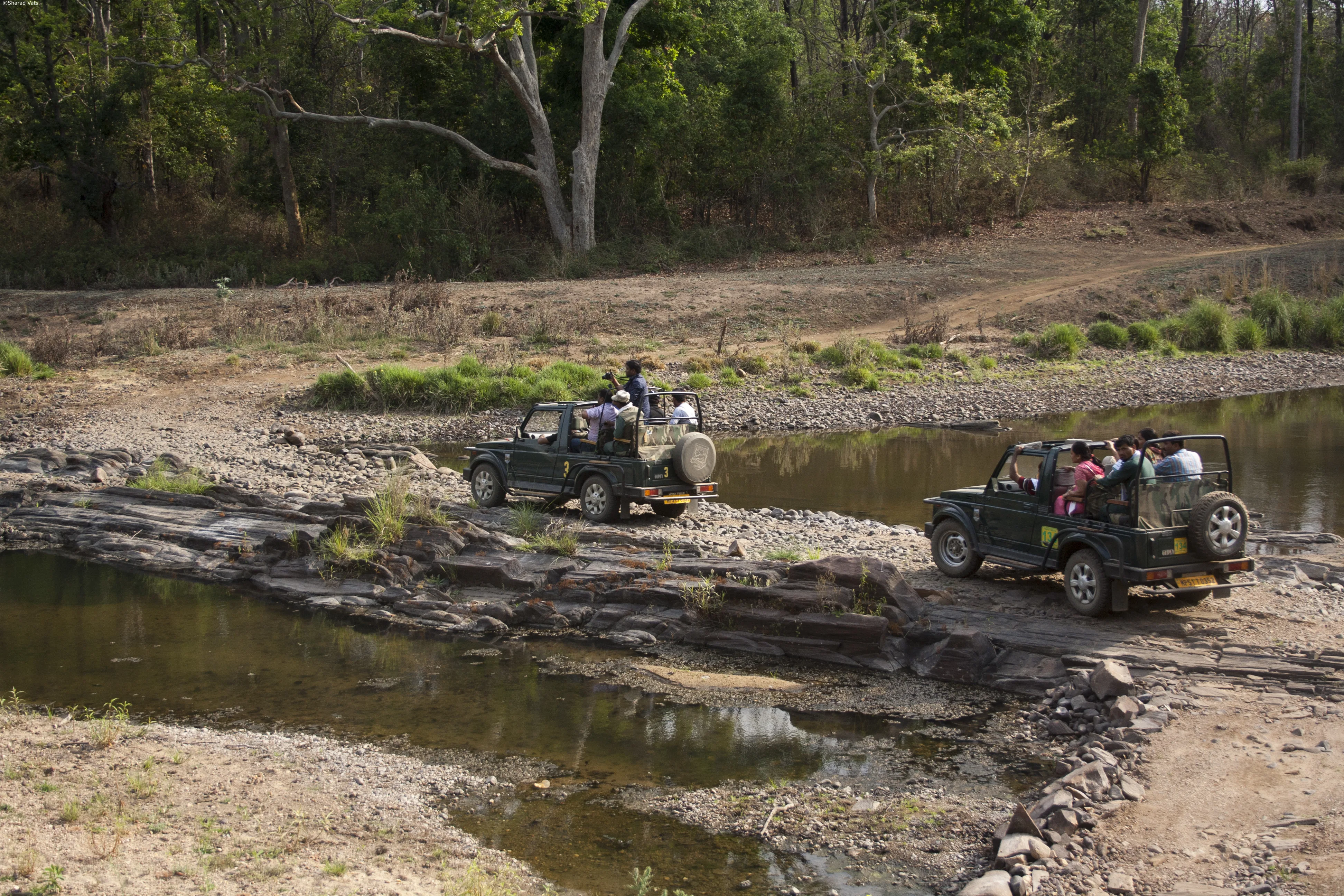
Jungle Safari Tour
It is an engaging activity where one has no choice but to actively participate in it. Looking at beautiful animals and birds is a wonderful way to spend time, and if a good Naturalist or Guide is present, it is a great learning experience as well.
A safari jeep can be booked on a private basis for the family up to 06 persons in a vehicle.
Safari Tour in India
On an Indian Safari, generally the search for the Tiger is always ongoing and being a very elusive animal, it keeps one excited all throughout. And if by chance you do see one, the collective delight is simply to be experienced to be believed.
Heck, your guide will be as excited as you even though he/she visits the park every day!
Moreover, learning about the ecosystem and all it encompasses is generally something that all of us should have an idea of, as it is in our own self-interest to have this awareness.
  • Rural Life/ Life in the Countryside: As it stands today, it is the well-endowed or the more fortunate of us who can afford a family holiday.
Most of us who visit, visit these areas with a perspective of the fast-paced “city life”.
A visit to the countryside or a village gives one an idea of how a completely different section of our society lives. It also provides an insight into the way of life of our ancestors who lived off the land on which they lived, in harmony with it.
In India, it is a humbling sight to see the hardworking farming families who meticulously plant each sapling of rice or wheat by hand and use their cattle to till the soil.
Once again, these are great lessons to draw from and can be inspiring for both, the young and the adult mind.
  • Walking in a Healthy Environment: Exposing oneself to the carbon positive environments of a forest area is extremely beneficial for our bodies as we leave behind the comparatively polluted city air.
India Bird Watching
There are several easy nature trails which one can partake in to enjoy the silence of the forest and surround oneself in the natural environs of butterflies, birds and other interesting creatures.
In a jungle, our lost natural instincts kick in and we are able to be more aware of our surroundings while learning about the tracks and signs of different animals.
On a guided walk, one also learns about the smaller creatures and the various uses and importance of indigenous plants, to the ecosystem as well as its traditional uses as medicine.
  • Noise-free Environment: In a greatly stimulating modern world where our minds are constantly occupied and the white-noise of the city takes over, a venture into nature gives us the opportunity to take stock of where we are, and the noise-free environment provides much relief to the mind and body.
On a safari holiday, deep in the interiors, one notices the clear distinction between night and day as dusk brings an end to the light as people retire early to their homes.
Thus, these are our compelling reasons to plan a safari holiday as a great family vacation. We do hope you agree with them!
Wildlife Safari Tour
Safaris in India are an increasingly popular holiday choice and most of these are based around observing the Tiger in the wild – as many will agree, it is a life-changing experience to see such a gorgeous animal in its natural surroundings and especially in a densely populated country as India.
These wildlife excursions are indeed exciting, and no matter how many times one sees them, each glimpse of the Tiger keeps one coming back for more.
Tiger Safari India
There are various Safari Destinations in India, which are well-connected to other cities and other popular tourist destinations in India. You may follow our blog to get a fair idea of a few National Parks where one has great chances of seeing the Tiger here.
While India is generally known for its cultural history and diversity, a trip to see the Natural Heritage of India is equally immersing and is definitely an unforgettable experience.

Monday, 14 October 2019

Safari In Jim Corbett National Park, Uttrakhand, India

It was that usual time of the year when I go and see the new resorts / lodges that come up around the national parks. So packed off to the nearest and one of the best national parks of India. Distance from New Delhi is 275kms, time taken is 5-6 hours. Most of the journey is smooth on a four lane highway, A small patch of about 25kms, around Kashipur town is a bit busy hence the speed drops here. So checking out the resorts and doing a Safari in Jim Corbett National Park was the objective of my visit this May 2017.
Reached Ramnagar by noon, had lunch with a friend, and went to see the new resorts that have recently come up. Lemon Tree Hotels are coming up with a good place about 4 kms ahead of Dhangadi on Ranikhet road. And the Taj group has taken over a resort and turned it around completely into a nice gateway tucked in next to a river. Dinner at Taj gateway reinvigorated my memories of working with the Taj. Food has been as delicious as always, and it gave a feel of a nicely managed resort in Corbett.

Safari in Jim Corbett National Park begins

Got up the next day, me and my camera fully charged for the next 60 hours of my engagement with nature. Entered by Dhangadi gate, and after doing the registration formalities the safari began with our baggage in the jeep, and camera equipment on our seats.
The First thing that starts to happen when the safari begins is deep breathing. You become conscious of your breath and start to enjoy it. Seems like you have just started to breathe. You can clearly visualize where is your breath going in, reaching, and returning. This is the magic of the forest.
Crossing the Sultan rest house on the right, and still getting used to the reality of Corbett, Gopi (my driver) braked, keenly looked upwards, and in a low tone hushed and pointed a Long-tailed Broadbill on the tree to our left. I saw it, and was mesmerized by this rare beauty.


Long-tailed Broadbill

This was an ominous beginning to our safari. We continued and in another 20 minutes of drive, he barked again. This time he looked over his right shoulder, pointing at a distance of about 40 meters in anesthetic tone he murmured, “Sir, Yellow-throated Marten”. I saw it looking towards me, I lifted my camera and off it went. Photo taken only in my mind.

Dhikala Forest Rest House

After a good one and half hour of the drive, we reached the famous Dhikala Forest Rest House. Over 100 years old, overlooking the Ramganga river and the foothills of Shivalik. Checked in quickly, finished, left our bags in the allocated hutment, and had perhaps one of the best breakfasts ever. Fresh Aloo Poori, and a cardamom tea.


Old FRH in Dhikala

The afternoon safari in Jim Corbett National Park in Dhikala zone usually starts towards Sambhar road until there is some news from Thandi Sadak. So we also moved towards the area, and before long crossed over the wooden bridge on the Ramganga river.
While on the bridge, the driver noticed a Checkered Keelback snake with something in his mouth. Unsure of what it was, I clicked for records sake, and was happy that Gopi noticed the Snake right on the bridge. I have often noticed that almost all the drivers are very careful while driving in the national park. Nothing living to a naked eye ever goes under their wheels.


Checkered Keelback

Crossed the river and reached the water hole, popularly known as the swimming pool of the legendary Paarwali. She was not around. Par means “the other side of the river”. So Paarwali means a Tigress on the other side of the river. Spent some time looking for her, no luck. Got back to the rest house, the vehicles that came last said that they saw her crossover from one side of the bus to the other. No regrets, as we knew we had 3 more safaris to go.
Next day morning, the search for Paaro began again. While on Sambar road, we saw a herd of Elephants crossing the river, it was but obvious that they would do the dust bath before heading into the woodland. Stopped, and how one hour went by, did not realize.


Asian Elephant gives a dust bath

What followed this was even more spectacular and totally unexpected. Elephants mounting (mating)


Elephant mating seen from the Sambar road in Dhikala.

Gopi was getting a bit edgy as we were more engaged in Elephants while he wanted us to see Paaro. We relinquished to his wish, and crossed the river. Saw some vehicles coming back with some delighted faces. I knew they had seen Paaro. We did not even ask, and they voluntarily informed that she was sitting in her favorite pool for over 30 minutes. Gopi’s expression fell, not mine. Though I wanted to see her, but I was more than delighted with the Elephant show I just witnessed.
Same evening we witnessed another beautiful sight in the grasslands, locally known as “Chaur”. The sun was setting, the sky was turning crimson red, and I saw a lone Tusker at a distance. He obliged by moving into the frame, I lifted my 300mm prime and realized he was still not in a frame on my lens. Sun was setting fast, Elephant was moving faster, I had to get him in the frame, I asked Gopi to reverse. We backed good 100 meters to get this Tusker in the frame, and what resulted was something like below. What an amazing safari in Jim Corbett National Park.


Tusker & Sunset in Dhikala

A new morning safari in Jim Corbett National Park

Every day is a new day in a Jungle, and enthusiasm does not dilute by not seeing what you wanted to see, rather there is happy to have got something you never expected. The journey in search of Paarwali commenced. Crossed the river, entered the woods, and we see two vehicles standing in front of us, silently, with people standing silently, the only sound was the camera clicking. Even a blind person would know that the Tiger was in the vicinity. We found a small opening between the two vehicles, and saw this beauty sleeping just next to the road. She wanted me to believe that she had rejected our presence, but the careful twitching of her ear with eyes still closed signified that she had noticed and accepted our advent.


Paaro relaxing by the road.

After about a good half an hour she decided to get back and move into the bush. She moved in about 5 steps. And we also moved in about 5 steps. The reason for her movement was soon obvious. She heard some footsteps of unsuspecting deers, and she was alert. Ears, eyes, and all muscles focussed. The stillness was so magnetic, that  I also became still behind the eye-piece. Seconds, and minutes passed, she was looking away from the lens. I had kept my focus ready, but she wouldn’t look. Looking with one eye, and the second closed for long can be a bit strenuous on the eyes. But I did not want to take a chance of giving my eyes a break.
A good 15 minutes passed, it seemed like eternity and she was just not obliging me with a glance. I realized she was testing my perseverance. Soon a prayer started in my mind requesting her to look my way but once. Finally, she did, my forefinger fired, and she continued to look for a good 15 seconds without blinking. As if conveying, “Happy? Is that enough, or you want more?” I did not want more.


Paarwali, aka Paaro

I had just seen one of the most gorgeous Tigresses in recent times. By the time we moved from there, we realized that we had been in her majestic presence for over three hours. Three safaris searching for her no outcome, and then she presents herself, in her Kingdom, in the way she wanted us to see her. While I was wanting to see her in the pool, as I had seen her images on social media in a pool. But she had something else in mind, and I was euphoric with the look she gave me.
Time to check out, left Dhikala Forest Rest House and headed for the outward journey. It was about 11am. I kept my camera ready for the Elephants who always come to say bye to me on the road from Dhikala to Dhangadi. Gopi said, “not at this time, sir, it is very hot”. Well, there are no experts in wildlife is what I know. Half a kilometer into the track, and I see a herd on the left as if waiting to say bye to me. I said bye by taking the last image of the trip and drove back to New Delhi. Safari in Jim Corbett National Park had come to an end.
A complete trip in all ways, everything ticked, resorts, Dhikala, Elephants, and Paarwali graced us by her company.
Best Wishes
Sharad Vats